
It was around August 2019, a few months before the year ended. That night, Malang felt calm as usual slightly chilly, a bit humid, and full of small street food stalls glowing under warm yellow lamps.
I was having a late dinner at a simple warung with some friends. At that time, I was working at a coworking and creative space in Malang. That space had introduced me to many people from different backgrounds designers, developers, founders, students each with their own stories and disciplines.
While we were waiting for our food, the conversation flowed casually. As far as I remember, it was me, Mas Fariz, and a few others whose faces I still remember, but whose names I can’t fully recall. The topics bounced from work, to campus life, to design trends that were popular at the time.
In the middle of that light conversation, a thought suddenly slipped out of my mouth:
“What if we create a design event that doesn’t only focus on one discipline? Not just graphic design, not just UI/UX which is super booming right now but something bigger?”
The table went quiet for a moment. Then, one by one, everyone’s expressions turned serious.
To give some context: I was active in IxDA Malang, a community focused on interaction design. Meanwhile, Mas Fariz came from ADGI Malang (Asosiasi Desainer Grafis Indonesia). We came from different design worlds, but that night, sitting at the same table, we shared the same question:
“What if all these worlds met in one event?”
From that spontaneous conversation, a shared vision started to form. We didn’t yet know what shape the event would take, how big it would be, or who would be involved. But we knew one thing: we wanted to make it real.
Over the next few days, I started to share the idea with friends from other communities. The concept was still very rough a mix of key phrases in my head: multidisciplinary, design, collaboration, Malang.
While I was trying to imagine what the event could look like, it turned out that on the other side, Mas Fariz was doing something similar. He had begun talking about it inside ADGI. At some point, we both realized: it was time to move from casual talk to real planning.
At that time, Mas Fariz was the Vice Chair of ADGI Malang Chapter. Through him, we arranged a time to meet with the Chapter Chair, Pak Andreas. That meeting became one of the turning points of this whole journey.
During our discussions, one realization stood out very clearly: Malang has a quiet but powerful strength its universities.
There are many campuses in Malang, and quite a few of them have Visual Communication Design (DKV) programs. That meant there was not only a lot of design talent, but also a strong academic ecosystem that could support this kind of event. The more we talked, the more we felt that Malang was actually the perfect place for a multidisciplinary design wave.
From there, we started reaching out to campuses one by one. We focused on universities with DKV or related design programs:
- Universitas Negeri Malang (UM), where Pak Andreas teaches
- STIKI Malang, where both I and Mas Fariz had taught
- Vocational Program of Universitas Brawijaya
- Universitas Ma Chung
- BINUS University Malang
Many lecturers from these campuses were also members of ADGI, which made collaboration feel more natural and organic.
At the same time, we didn’t want this event to be shaped only by campuses and formal associations. The soul of design in a city often lives in its communities. So we began approaching them as well.
We started with:
- Lettering Malang, through its coordinator Mas Dimas Fakhrudin
- WRI Polinema, a campus community we invited to join as part of the organizing committee
- Game Developer Malang (GDM), representing the game and interactive media side
We also tried to involve professional associations such as:
- IAI (Ikatan Arsitek Indonesia)
- HDII (Himpunan Desainer Interior Indonesia)
IAI and HDII, at that time, were not yet able to officially join. But mentioning them already expanded how we thought about “design” itself: not just posters or interfaces, but also buildings, spaces, and interiors.
In the end, our confirmed ecosystem of communities and associations looked like this:
- IxDA Malang
- ADGI Malang Chapter
- Lettering Malang
- WRI Polinema
- GDM (Game Developer Malang)
It felt like a small but powerful design ecosystem had gathered around a shared idea.
Once everyone was more or less on board, a new question came up:
“What theme can unite all these disciplines?”
We didn’t want a theme that was only catchy on posters. We wanted something that reflected the reality of design work: that design is not only about aesthetics, but also about function and impact.
After long discussions, small debates, and ideas going back and forth, we finally agreed on one phrase:
“Between Visual and Usefulness”
Those four words became our anchor. They captured what we wanted to talk about: the space between beautiful visuals and real usefulness. In that space “between,” we felt all design disciplines could meet.
With the theme in place, we began shaping the overall structure of the event. We didn’t want just a one-day seminar that ended with group photos and social media posts. We imagined a journey that people could really experience over time.
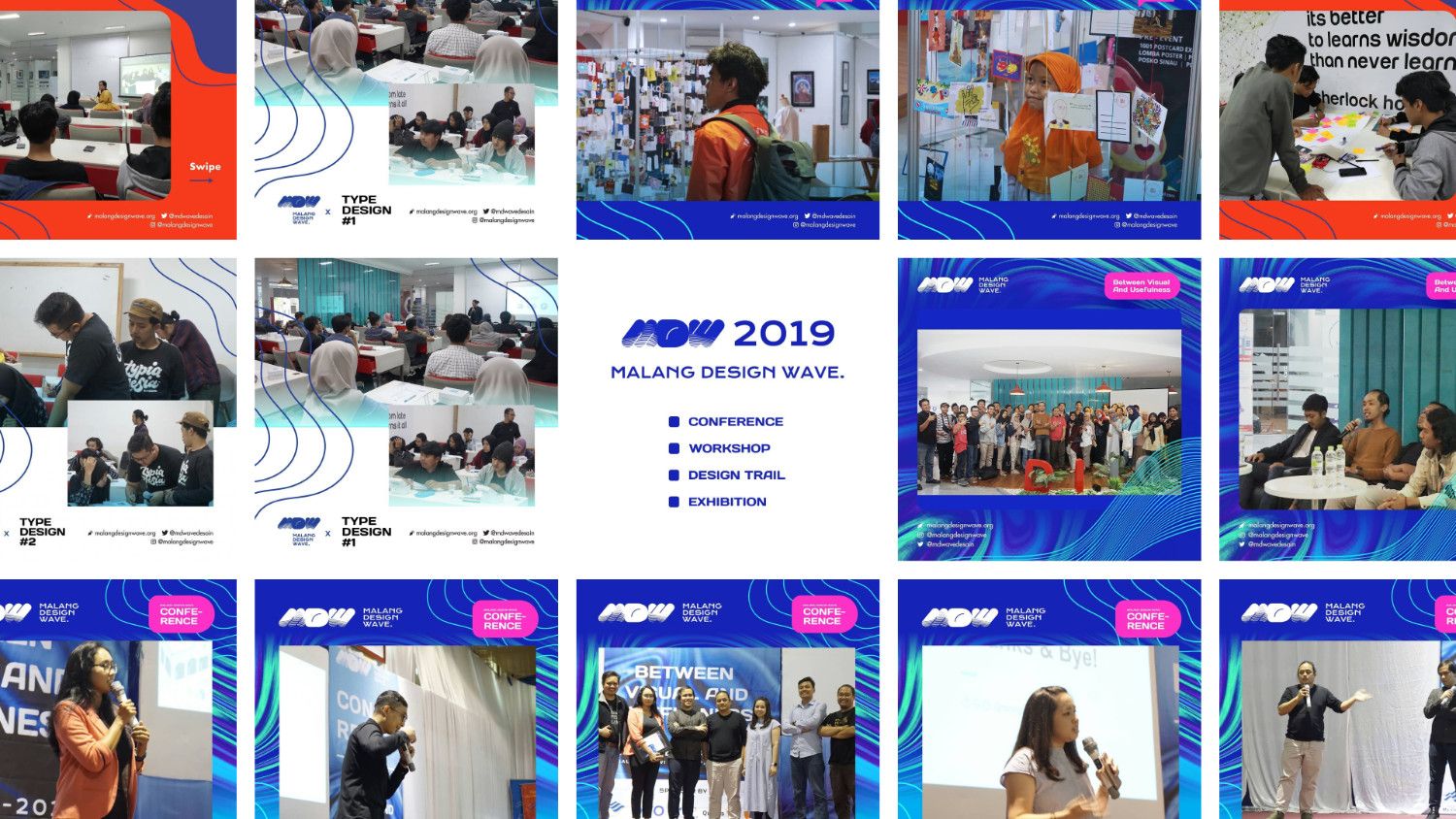
In the end, we decided on a four-week series with four main formats:
- Conference
- Workshops
- Design Trail
- Exhibition
Each format played a different role, but together they formed a complete narrative from learning and practicing, to exploring and showcasing.
The Design Trail
brought a different kind of energy. Instead of keeping everyone in a single venue, we invited participants to “walk through” and experience design practices more closely.
We held a talk show featuring several prominent designers in Malang who run their own studios and agencies:
- Affan Hakim – Odigiro
- Arief Setyo W – TypiaNesia
- Krisnawa Adi B – Polamata
Workshop Series
They shared stories about starting a studio, dealing with clients, building teams, and staying creative while managing the business side of design. The Design Trail helped participants see that design is not only an academic subject, but also a living profession with daily challenges and real projects.
We also hosted several more specialized workshops to deepen specific skill sets:
- Type Workshop – Arief Setyo W (TypiaNesia)
- A workshop on creating lettering and fonts, turning letterforms into consistent, usable type systems.
- Malang Dribbble Meetup – Reno Yuansyah (24Slides)
- A hands-on session on how to create icons and icon packs that are visually coherent and functionally clear.
- “Mengemas Indonesia” – Packaging Design Workshop
- Led by:
- M. Immaduddin – Chairman & Board of Jury ASPaC Indonesia / ADGI
- Adityayoga – Committee & Board of Jury ASPaC Indonesia / ADGI
- This workshop focused on packaging design and how it can elevate local products, helping Indonesian brands stand out both locally and internationally.
The Exhibition
became the visual heart of Malang Design Wave.
We organized a main exhibition with an open submission system and collaborated with several campuses:
- DKV Universitas Negeri Malang (UM)
- STIKI Malang
- BINUS University Malang
- Universitas Ma Chung
Through the open call, we even received works from outside the city, including Bali. That was a special moment it showed that the wave we were trying to build was starting to travel beyond Malang.
We also collaborated with Posko Visual, the annual exhibition by DKV UM students. Their works added fresh energy and bold experimentation to the space.
The exhibition ran in parallel with the workshops. So on one side of the venue, people were learning and practicing; on the other side, people were observing and appreciating. Theory, practice, and appreciation lived side by side in the same time frame.
The conference was the closing ceremony
One of the most intense parts of the process for me personally was curating speakers for the Conference.
To bring depth and perspective, we wanted speakers who were not only experts, but also generous storytellers. I started reaching out to several well-known figures in the design world.
Some of the key names were:
- Naning Utoyo – Senior UX Researcher at SP Digital Singapore (at that time)
- Stevanus Christopel – VP of Design at OVO (at that time)
Reaching out to them felt a bit like shooting my shot beyond my comfort zone. But I tried anyway.
What happened surprised me: they responded positively. Not only did they support the concept, they also agreed to come and speak at the Conference.
Through Naning’s recommendation, we were also introduced to:
- Gathi Subekti – Architect at Arkana Architect Bali
Then, with the help of Pak Sasha, an ADGI member, we managed to connect with:
- M. Immaduddin – Chairman & Board of Jury ASPaC Indonesia / ADGI
- Adityayoga – Committee & Board of Jury ASPaC Indonesia / ADGI
At that point, it felt like the puzzle pieces were coming together:
- Interaction design
- Graphic design
- Architecture
- Packaging design
- Type and lettering
- Game development
- Campus communities
- Professional studios and agencies
All of them stood side by side under one event.
The multidisciplinary design ecosystem we had once only imagined at a small warung table was now standing in front of us real and tangible.
Finally, the day of the Conference arrived the last event in the Malang Design Wave series.
Looking back, it almost felt surreal. What started as a late-night conversation at a food stall, with simple questions and rough ideas, had transformed into a month-long series that connected so many people, disciplines, and institutions.
From workshop rooms to exhibition halls, from studio talks to conference stages, one thing remained consistent: design was not just being discussed; it was being practiced, shared, and celebrated together.
All events from the first workshop to the final Conference ran smoothly. Of course, like any event, there were challenges and last-minute adjustments. But the overall wave kept moving forward.
And this story wouldn’t be complete without mentioning the people behind the scenes.
There were so many committee members, volunteers, and friends whose names I can’t list one by one. But each of them left a mark through:
- Late-night planning sessions
- Long chat threads and calls
- Quick improvisations when something didn’t go according to plan
- Small but meaningful acts of support
To all of you: thank you.
Together, we built what, at that time, felt like the coolest multidisciplinary design event in Malang. Not just because of how big it was, but because of the spirit behind it: bringing together many design disciplines in one shared wave.
A wave we decided to call: Malang Design Wave.