
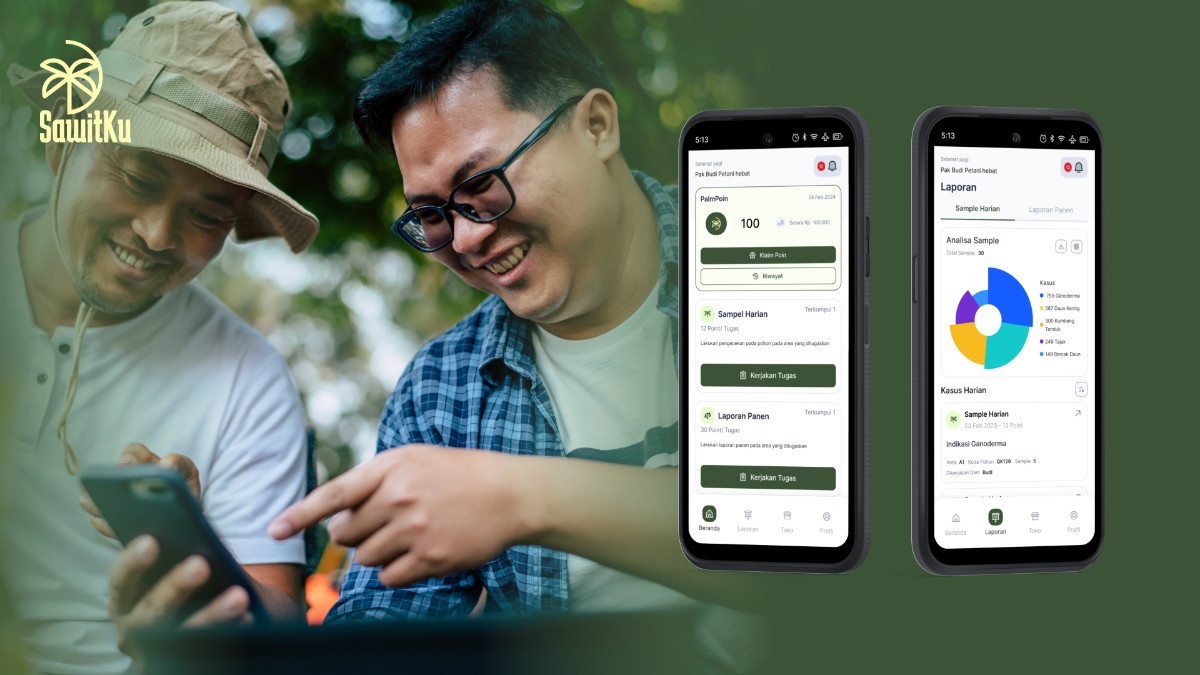
Heri is a 38-year-old former FMCG manager from Jakarta who recently decided to return to his hometown, a rural area four hours from Pekanbaru, to take over his family’s 20-hectare palm oil plantation. Although he has a background in management and some experience working with systems, he is not particularly tech-savvy. Most of his workers are old school friends whose education stopped at high school and who mainly use their smartphones for WhatsApp, YouTube, and Facebook. Heri sees that the plantation has the potential to generate more than double his previous salary, but to achieve this, he needs a more structured way to manage workers, monitor tree health, and make data-driven decisions about fertiliser use. This study case explores how a simple, mobile-first solution can help Heri streamline farm management, motivate workers, and increase productivity despite limitations in technology adoption and infrastructure.
The core challenge was to design an application that could effectively support farm management in a low-tech, low-connectivity environment while aligning with the needs of two very different primary users: Heri as the plantation manager, and Budi (and other workers) as on-the-ground operators.
From the business and operational side, Heri needed a way to:
- Regularly collect photo samples of oil palm trees so that diseases and conditions could be detected early through image-based analysis and machine learning.
- Translate these samples into clear, actionable insights on farm conditions and fertiliser recommendations to improve yield.
- Track worker performance and ensure that daily checking tasks were actually completed across a large plantation area where disease spread can be extensive.
From the human and environmental side, several constraints emerged:
- Limited internet coverage across much of the plantation, making real-time data submission and synchronisation difficult.
- Workers with basic smartphone literacy, who might resist complex new tools and already rely mainly on social and entertainment apps.
- The difficulty of finding loyal, reliable workers, which means Heri cannot be overly strict and needs a motivational system rather than pure control.
The design challenge, therefore, was not only about disease detection and data collection, but also about creating a simple, motivating experience that fits into workers’ daily routines, functions with intermittent connectivity, and still gives Heri the visibility and confidence he needs to manage the plantation.
Research
I explored the palm oil industry, common diseases, and existing image-based detection methods, and studied Heri and his workers’ context (skills, tools, and connectivity) to understand real constraints on the field.
Define
I synthesized insights into clear problem statements, created personas for Heri and Budi, and clarified goals around simple data collection, decision support, and motivation in a low-connectivity environment.
Ideation
I generated solution ideas using How Might We questions, mapped user journeys for Heri and Budi, and outlined information architecture and key flows like registration, daily tasks, and point redemption.
Design
translated the flows into simple, low-fidelity wireframes focusing on clarity, ease of use for non-tech-savvy workers, and clear visibility of plantation health and worker activity for Heri.
Protoype
I built a clickable Figma prototype connecting onboarding, daily task submission, analytics, and rewards, enabling early validation of the concept and its potential business model.
The final solution concept was a mobile application that delivers daily, structured tasks to workers, guides them to submit photo samples of oil palm trees, and converts those inputs into actionable insights for Heri. The app’s core flows cover onboarding, daily worker activities, analytics for disease and fertiliser recommendations, and a points system where workers earn rewards for consistently completing tasks. By introducing a point-based incentive mechanism, the design aims to increase task completion rates without relying solely on strict supervision, which fits Heri’s constraints around workforce management.
Through background research on palm oil production, disease patterns like Ganoderma-related basal stem rot, and existing image-based detection approaches, I validated that disease detection can be supported via photo samples and machine learning models. This informed the hypothesis that regular, structured image collection at scale could meaningfully help early detection and treatment decisions. Mapping separate user journeys for Heri and Budi revealed key emotional transitions: Heri’s path from feeling overwhelmed to empowered through data-driven decisions, and Budi’s path from skepticism and anxiety around new technology to confidence and pride as he masters the app and sees its benefits.
Key learnings from this study case include the importance of designing for low-connectivity contexts (e.g., offline-first flows and later synchronisation), simplifying interactions for users with limited tech experience, and combining functional value (analytics, monitoring) with intrinsic and extrinsic motivation (points, rewards, recognition). Additionally, involving both manager and worker perspectives early via personas, “How Might We” questions, user journeys, information architecture, and wireframes helped ensure the solution balanced business needs with everyday realities on the ground, ultimately making the concept more feasible and adoptable in a real plantation setting.