
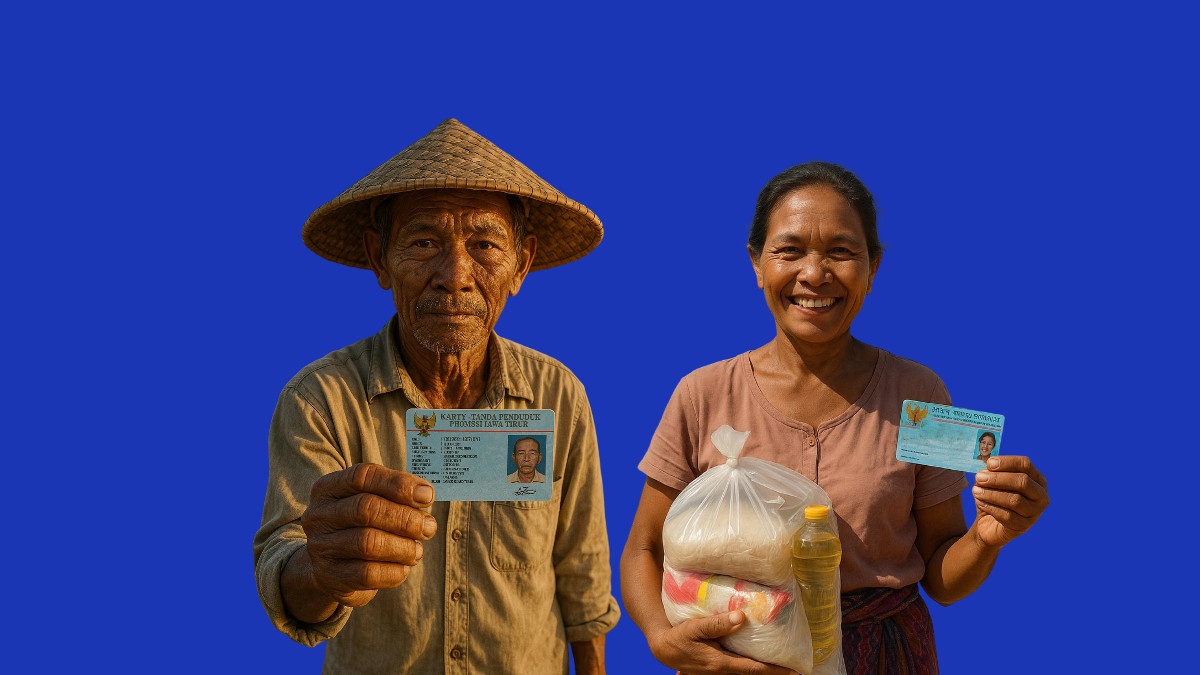
In Indonesia, financial inclusion has grown steadily, yet millions of people in 3T regions (Tertinggal, Terdepan, Terluar) still struggle to access basic banking services. Even though more than 98% of Indonesians already have an e-KTP, and over 275 million citizens are recorded in the national population database, this digital identity is not yet fully connected to the formal financial system. As a result, opening a bank account, receiving non-cash social assistance, or making digital payments remains difficult for many.
SakuNegara is our proposed solution to close this gap by turning NIK/e-KTP into a single, universal financial identity. By linking NIK directly to a Virtual Account (VA), and enabling the physical e-KTP card (with NFC) to function like a debit card, SakuNegara aims to simplify onboarding, reduce operational costs, and make digital financial services more inclusive especially for people living in 3T areas. This initiative aligns with Bank Indonesia and OJK’s agenda on financial innovation, digital identity, and national payment interoperability (BI-FAST, QRIS, and the national financial inclusion strategy).
Despite multiple national initiatives such as Laku Pandai (branchless banking), e-wallets, and financial literacy programs, there are still structural challenges that prevent equitable access to financial services in 3T regions:
- There is a visible gap in financial inclusion between urban and rural areas. While urban financial access reached around 84% in 2021, rural areas lagged at approximately 69%, with some provinces like Papua Barat, NTT, Gorontalo, and Papua showing even lower inclusion rates.
- Existing systems often require repeated registration, manual verification, and stable internet connectivity conditions that are not always available in 3T regions.
- The current infrastructure does not provide a unified, automatic way to link NIK to bank accounts, e-wallets, or government assistance programs. This increases complexity for users and operational costs for financial institutions.
- From the regulatory and operational side, institutions must comply with e-KYC requirements (BI and OJK regulations) while still dealing with fragmented data sources and manual processes, which slows down onboarding and increases the risk of fraud or identity misuse.
In short, the core challenge is how to transform NIK/e-KTP an identity that almost everyone already has into a practical, secure, and interoperable financial access key, without demanding heavy infrastructure or complex digital literacy from the people in 3T regions.
Discover
Focuses on understanding financial inclusion gaps in Indonesia’s 3T regions through data, regulations, and user context, including how people currently access (or fail to access) banking and social assistance.
Define & Ideation
Turns research findings into a clear problem statement and solution direction by framing how NIK/e-KTP can act as a single digital identity, and exploring concepts around agents, virtual accounts, and NFC-based transactions.
Wireframe
Maps the end-to-end journey for 3T users, agents, and banks into simple flows and low-fidelity screens to validate key steps such as onboarding, e-KYC, balance checking, and receiving government aid.
Design
Applies a consistent visual system and interaction patterns for mobile and web, ensuring the interface is accessible, lightweight, and intuitive for first-time digital banking users in low-connectivity environments.
Through SakuNegara, we designed a concept and technical approach that demonstrates how NIK can function as a unified financial identity, supported by AI-based e-KYC and NFC-based e-KTP usage in the field. Our proposed system:
- Links NIK to Virtual Accounts so that one identity can seamlessly access bank accounts, e-wallets, and government programs.
- Uses AI (face recognition, selfie detection, and KTP segmentation) to automate identity verification while still complying with BI and OJK’s e-KYC, APU-PPT, and digital banking regulations.
- Enables low-friction onboarding and transactions through local agents (warung, village offices) equipped with simple devices such as NFC readers and POS terminals.
From this project, we learned several key points:
- Identity as infrastructure is powerful: Treating NIK/e-KTP as a core financial identity layer can significantly reduce onboarding friction and costs. When identity and payments are unified, it becomes easier to distribute social aid, expand branchless banking, and connect multiple financial products for the same user.
- Technology must adapt to the context, not the other way around AI, NFC, and mobile apps are only effective if they are designed for real constraints in 3T areas limited connectivity, varying levels of digital literacy, and dependence on local agents. This pushed us to design flows that work offline-first, agent-assisted, and mobile-first rather than assuming urban-level infrastructure.
- Regulation and collaboration are as important as product design A solution like SakuNegara cannot stand alone as just an app or a backend system. It needs alignment with regulators (BI, OJK), integration with Dukcapil data, and collaboration with banks and local governments. Understanding the regulatory landscape (POJK, PBI, e-KYC guidelines) was critical to make the proposal realistic and implementable.
- Business model and sustainability matter for inclusion We learned that financial inclusion products must also be economically viable for banks, agents, and technology providers. By designing a transaction fee model inspired by existing schemes like QRIS where revenue is shared across stakeholders we showed how SakuNegara could sustain operations while still being affordable for users and relevant for 3T programs.
- Human-centered design remains the foundation Behind all the technology and regulation, the ultimate measure of success is whether people in 3T regions can easily open accounts, receive benefits, and perform day-to-day transactions with confidence. This reinforced our belief that every technical decision AI models, KYC flows, NFC usage must be guided by clear user journeys and simple, understandable experiences.
Overall, SakuNegara strengthened our understanding that inclusive financial innovation in Indonesia requires an integrated approach: combining national identity infrastructure, AI-powered verification, regulatory alignment, and a human-centered delivery model through local agents and simple devices. The concept may start as a hackathon proposal, but the insights can inform real-world collaborations to accelerate digital financial inclusion across Indonesia’s 3T regions.