
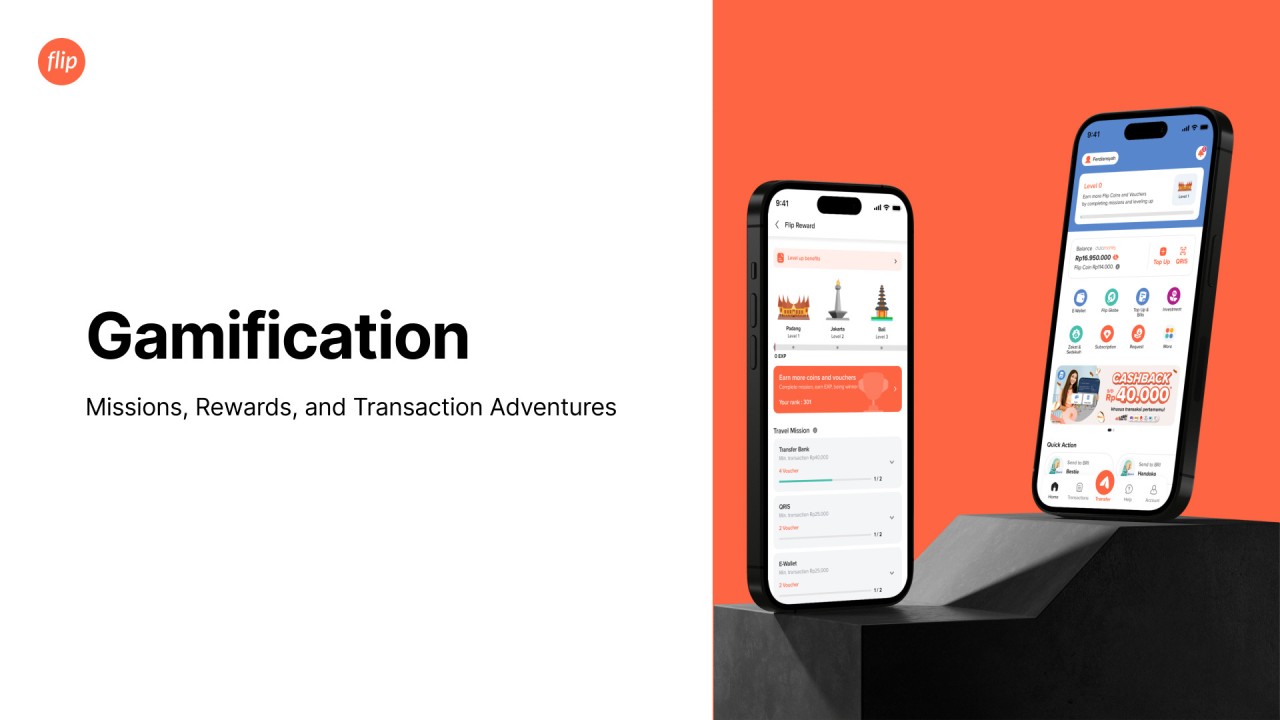
Indonesia’s digital transaction landscape has been growing very fast in both scale and value. Bank Indonesia reported that in 2023, total digital transaction value reached Rp 58.478,24 triliun with year-on-year growth of 13%. In 2024, this figure is projected to rise further by around 9,11% to Rp 63.803,77 triliun. This growth shows that more and more people are becoming comfortable using digital financial services in their daily lives.
In this context, Flip is one of the key players in Indonesia’s digital payment ecosystem. As of early 2023, Flip has achieved more than 10 million downloads with around 12 million users, supported by very good ratings on both Google Play Store and App Store. This traction proves that Flip is already trusted as a solution for interbank transfers and other basic financial transactions.
However, high acquisition and transaction volume alone are not enough. With a user base this large, Flip has a big opportunity to strengthen user engagement, encourage feature exploration beyond transfer, and create a more memorable and enjoyable experience. The Horog-Horog team saw this as a chance to explore how gamification could be applied to make Flip’s transaction journey more engaging, without sacrificing trust, simplicity, and efficiency.
This case study tells the story of how we:
- Mapped the current state of Flip usage through secondary data and quick research.
- Identified gaps in awareness and adoption of existing features such as Misi and Flip Koin.
- Formulated a gamification concept that aims to turn routine financial transactions into a series of meaningful and rewarding milestones for users.
From our initial exploration of the Flip app and user insights, we found several core challenges that became the foundation of the problem statement.
- The Misi (Missions) feature is practically invisible to users. Although the feature exists in the app, it is not populated or surfaced in a way that users notice and understand. In our survey, 92% of respondents admitted they did not even know that Flip had a missions feature. This indicates an issue of discoverability, communication, and integration with the main user journey. A feature that is not seen and not understood will not contribute to engagement.
- Flip Koin (the in-app reward currency) is underutilized and perceived as single-purpose. Currently, around 90% of surveyed users reported using Flip Koin only to buy mobile credit (pulsa). This shows that in users’ mental models, Flip Koin is not yet seen as a flexible or attractive reward system. Instead of becoming a driver of long-term behavior and loyalty, it is perceived as a small, transactional utility.
- There is a strong tendency toward single-feature usage. About 97% of respondents said they mainly use Flip for one primary feature: bank transfer. From a business perspective, this is both a strength and a weakness. It proves Flip’s strong product-market fit for money transfer, but it also means many other potential value-adding features are under-explored. Users are not naturally motivated to “walk around” and try what else Flip can do for them.
Combining these findings, we arrived at a central challenge:
How might we design a gamification layer that:
- Makes Misi visible, relevant, and valuable in the eyes of users.
- Expands the use case of Flip Koin from “just for pulsa” to a more compelling reward ecosystem.
- Encourages users to explore beyond transfers without disrupting or complicating the main transaction flows.
- Still maintains the sense of trust, safety, and seriousness that is critical in a financial app.
This challenge pushed us to think not only about adding “fun” elements, but about how to align missions, rewards, and progress with the real jobs-to-be-done that bring users to Flip in the first place.
Research
We started by exploring the Flip app and its role in Indonesia’s fast-growing digital transaction ecosystem. From this, we identified key features like Missions and Flip Koin, observed that most users rely on the transfer feature, and saw an opportunity to improve engagement with a gamification approach.
User Survey
We then distributed an online survey to 25 respondents aged 18–35 from various cities and professions. The goal was to validate how often they use Flip, which products they use most, how long they spend in the app, and how satisfied they are with their overall experience.
Interview & Data
Based on the survey, we selected several participants for short interviews. These conversations helped us understand why they mainly use only the transfer feature, why they are unaware of Missions, and how they perceive Flip Koin. We combined quantitative and qualitative data into clear insights and a focused problem statement.
Idea & Design
Grounded in those insights, we developed a gamification concept tailored to Flip users’ behaviors and motivations. We designed mission flows, reward mechanisms using Flip Koin, and new interface layouts, then turned them into high-fidelity UI designs and interactive prototypes.
Submission
Finally, we packaged our process, research findings, and design solution into a structured case study and prototype. This complete package was submitted to Flip Tech Summit 2024 to showcase how gamification can activate underused features and increase user engagement.
From this exploration, we produced a gamification concept that weaved missions, rewards, and progression directly into Flip’s existing transaction flows. Missions were designed to reflect real behavior (such as completing transfers, trying bill payments, or maintaining healthy transaction habits), while Flip Koin was repositioned as a more meaningful reward tied to clear benefits like fee discounts or partner offers, not just pulsa.
Even though this work was done as a concept for Flip Tech Summit, it led to several key learnings. First, gamification in fintech must feel transparent and trustworthy, not like a game that trivializes money. Every mission and reward needs simple logic and clear communication.
Second, inactive features rarely come alive through UI polish alone. Low awareness of Misi and the narrow use of Flip Koin showed that these features were not connected to users’ core motivations. Embedding them into the main jobs-to-be-done sending money, paying bills, managing cash flow proved more important than adding new visual layers.
Third, most users naturally behave as single-feature users in utility apps, and that’s okay. The role of gamification here is not to force exploration, but to gently nudge it by rewarding actions that are already meaningful to users, and suggesting adjacent features that feel relevant in the moment.
Overall, this case strengthened our understanding that gamification in financial products should act as a strategic layer to reinforce good behavior and deepen engagement, rather than a separate “fun” module. In a real product setting, the next step would be validating this concept with experiments to see its impact on awareness, repeat usage, and retention.