
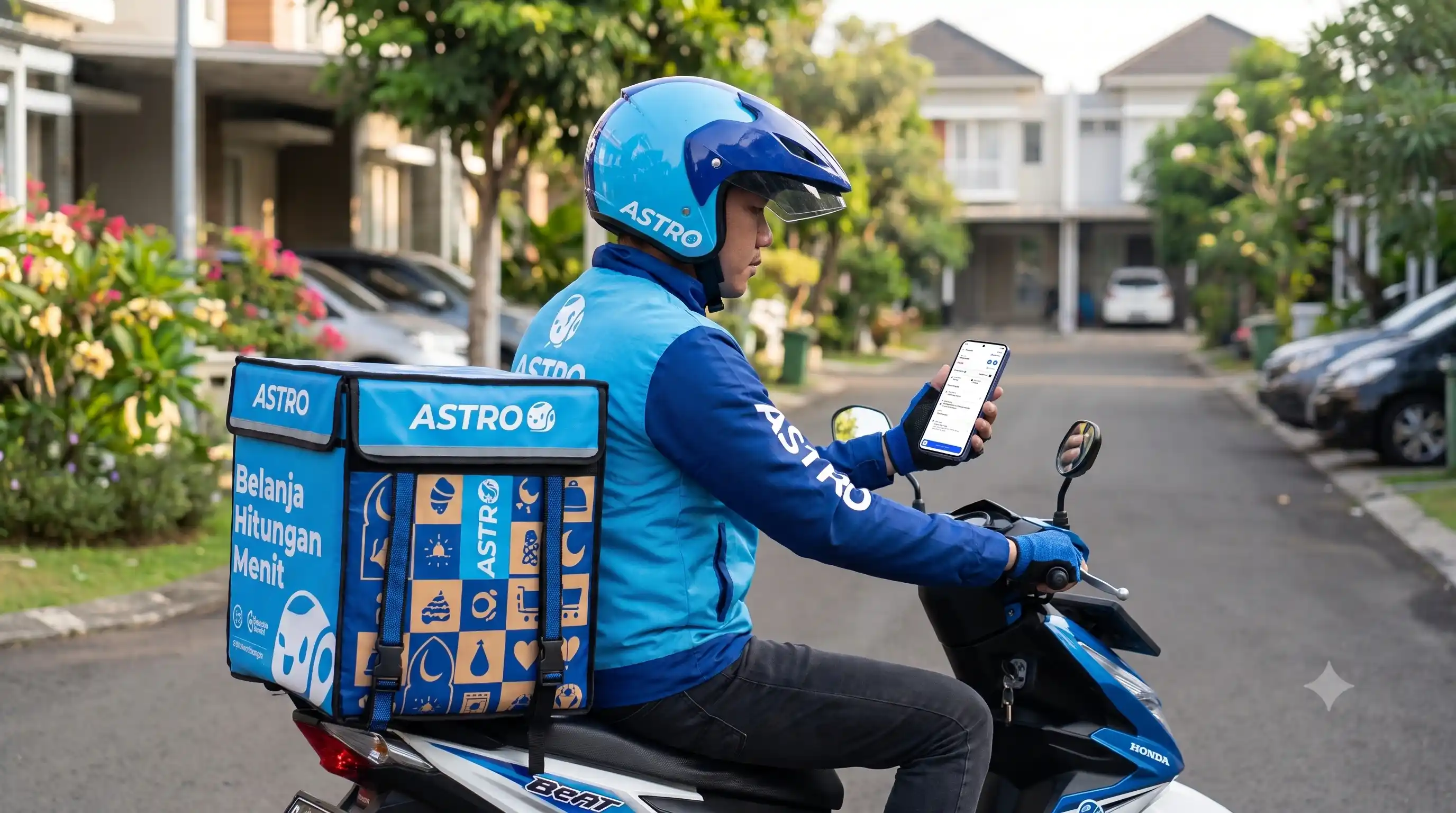
Groceries in minutes sounds simple until you follow a courier into the last 50 meters. Astro is an Indonesian quick-commerce service that delivers via “dark stores” and motorbike couriers, and the moment where the promise breaks is almost never the ride it’s the arrival and the handover. The driver is moving, outdoors, in a hurry, often one-handed on a motorbike with sun glare on the screen. That’s the reality this project designs for.
In this case study I redesigned the arrival-and-handover experience in the Astro Driver App, focusing on the journey of Awareness → Assurance → Delivery → Return to Hub. The business goals were concrete: improve delivery time, reduce wrong-address deliveries, and reduce customer complaints. This is an end-to-end walkthrough discovery, research, synthesis, two design bets, wireframes, high-fidelity flows, and an honest account of what design couldn’t solve in five days.
Two prompts framed the work the same moment (arrival → handover) seen through two different lenses:
Scenario 1 The “Last 50 Meters.”
A customer has been waiting a long time. The driver has the address but still can’t pinpoint the exact spot: the pin is slightly off, the gate isn’t obvious, the building is hard to find, or the address text is ambiguous. How do we get the driver from “I’ve arrived in the area” to the customer’s door?
Scenario 2 The “Silent Handover.”
The customer doesn’t want a phone call busy, in a meeting, or not home and wants the order left somewhere. How do we design the handover without a phone call as the primary action?
| Dimension | Scenario 1 Last 50 Meters | Scenario 2 Silent Handover |
| Core problem | Driver can’t pinpoint the exact spot | Customer can’t/won’t take a phone call |
| Root friction | Off pin, unclear gate, ambiguous address | Customer busy, in a meeting, or not home |
| Skill tested | Wayfinding / spatial problem-solving | Communication design without a call |
| Key constraint | Precision in the last stretch | No voice call needs alternative contact/drop logic |
| Emotional stakes | Customer already waiting a long time | Customer wants the order left somewhere |
The Indonesia-specific reality shaped every decision: dense kampung alleys, unnamed streets, inconsistent house numbering, gated complexes, security posts (satpam), one-way lanes, and GPS drift in narrow lanes with a driver who’s rushing, incentivized by speed, and juggling the next order.
Core challenge:
How might we help drivers complete the arrival and handover accurately pinpointing the exact spot when the pin is off, and completing a safe handover when the customer is unreachable without leaning on a phone call or a call to CS?
Discover
I broke down both scenarios and triangulated three sources so no insight rested on a single voice: a self-experiment (dogfooded two pooled orders on two devices, same address and recipient), three driver interviews (Apri · Apandi · Hermawan how they actually solve it), and customer reviews from Play Store + App Store (how failure feels). Honest framing: reviews show severity, not frequency (nearly all 1-star, self-selected); n=3 drivers is directional, not conclusive.
Define & Ideation
I set boundaries to keep scope from expanding, then narrowed each scenario to a single “How Might We” and explored directions against field reality including killing the strongest-looking idea (an in-app map) because it didn’t fit how drivers actually work.
Wireframe
Low-fidelity flows and screens for both scenarios, split into sub-flows so each design decision could stand on its own. Functionality over aesthetics, built to iterate fast.
Design
High-fidelity screens and prototypes for every branch of both scenarios, each flow annotated with the design decision behind it.
Discover What the field said
The pin can’t be trusted, contact is fragile, and CS quietly holds it all together.
| Theme | Strength |
| Pin can’t be trusted → driver becomes a manual detective (urut nomor · nanya warga · geser pin) | ●●● |
| Synchronous contact fragile + WA now banned | ●● |
| CS = backbone of every failure path, but a bottleneck | ●●● |
| Drop/leave needs environment judgment + photo proof | ●● |
Maturity callout: The sources disagreed on contact two said broken, Apri said “fine so far.” I didn’t average it away: contact is inconsistent, and WA (the old fallback) is gone. Note: unilateral cancellation and chat/phone routing are system/policy issues acknowledged, not solved in the arrival UI.
The insights held from three angles:
| Insight | Driver | Customer | Experiment |
| Wrong point = wrong address | urut nomor, nanya warga | “titik selalu melenceng” | — |
| Contact fragile, WA gone | chat putih, telpon mati | “diam di HP”, “tak dikabari” | notif Device 2 tak muncul |
| Silent handover needs instruction + proof | lapor CS, nilai lingkungan | “catatan titip diabaikan driver” | — |
Every insight mapped back to a stated Astro objective: wrong-address ← pin can’t be trusted; complaints ← fragile contact + drop-instruction-ignored; delivery time ← the 200m notification (customer ready on arrival).
Define Two design bets
Scenario 1 HMW:
Help the driver find the exact spot when the pin is off by replicating what they already do manually (landmarks, house-number sequencing, asking around) without calling CS.
Scenario 2 HMW:
Ensure the customer’s drop instruction reaches the driver clearly and actionably on arrival, let the driver assess safety and capture photo proof, so the handover completes without a phone call and without a unilateral cancellation. (This one attacks the correct root the instruction never arrives rather than the symptom of a “missing drop feature.”)
I killed the strongest idea for the right reason. The tempting option was to overlay landmarks inside an in-app map. I rejected it on three field constraints: the Astro Driver App has no in-app map (“Buka Maps” hands off to Google Maps confirmed by driver Hermawan); building one adds cost and time; and the Driver App must stay light because many drivers use low-end phones a heavy map burdens the very people it serves.
| Direction (S1) | Verdict |
| Customer provides landmark | Backbone |
| Previous driver’s correction | Embedded |
| In-app map layer | ✗ Rejected costly, must stay light |
| Driver self-service wayfinding | Cold-start only (see limits) |
The approach Scenario 1: crowdsourced landmarks, kept light
Two sources fill the same gap and cover each other. Customers add a photo + text at calm, high-motivation moments (address setup, post-failure, tracking, checkout nudge for risky addresses). Drivers correct or add after delivery, which persists for the next driver so a new address the customer skipped is covered by the first driver’s fix.
The driver experience is awareness without interruption the driver decides when to look:
- 200m → tappable early-warning banner in the destination card; orange to stay legible in daylight
- 50m → escalates (close now, don’t overshoot)
- Tap → pop-up with photo + text
- Two one-tap actions: “tidak sesuai” (opens correction) · “sudah sesuai” (optional, not a gate)
- Mark now, fill later: flag in the rush, add detail after delivery
Three sub-flows, one loop: Sources (customer + driver) → Awareness (banner → view) → Accuracy (confirm / correct), with driver corrections feeding back to sources. One loop, not three features the system gets better the more it’s used.
The approach Scenario 2: permission and judgment must pair
The problem isn’t a missing “drop” feature the instruction never reaches the driver. Customers already write “titip ke satpam / depan pintu,” but drivers miss it, call, or cancel. The real problem has three layers: the instruction must arrive, the driver must judge safety, and the handover needs proof.
| Direction (S2) | Role | Verdict |
| Customer pre-set drop permission | Gives authority to leave it | Backbone |
| Driver assesses on-site + photo | Gives safety judgment + proof | Backbone |
| Async 1-tap reply | Contact without a call | Folded into 200m notification |
| Alt. handover point (satpam/locker) | Certainty where it exists | Only where infra exists (kampung has none) |
Permission without judgment drops parcels in unsafe spots; judgment without permission makes the driver liable. They must pair.
The handover screen one form, an adaptive banner. The same “Pengecekan Paket” screen serves both branches; nothing new to learn. Photo stays the existing “Foto Paket” step (Langkah 2), unchanged. The banner is two-state and it acts, not just informs:
- Ada izin: shows the customer’s instruction read-only → guides driver to photo + a tap-select “Diserahkan ke:” ([Penerima] [Satpam] [Depan pintu] [Loker], no typing; satpam/locker shown only where they exist)
- Tak ada izin: blocks the drop “Selesai Antar” is gated, and the primary action becomes “Hubungi CS,” so the driver can’t leave a parcel unauthorises
Rationale: a banner alone can be ignored, so in the no-permission state, completion is gated not just warned. Escalation reuses “Bantuan CS,” already in the header. The 10-minute wait is an escalation trigger, not a liability transfer to the customer.
High-fidelity flows (walkthrough)
Scenario 1 Last 50 Meters:
- Landmark awareness: Reusing the 200m auto-reminder, the driver is notified a landmark exists; a second nudge fires at 50m. The driver can view photo + note while riding and search on.
- Validated negative case: Driver marks “Belum Sesuai”; a light, non-blocking alert lets them update the landmark during package check.
- Validated positive case: Driver marks “Sudah Sesuai”; the system notes this helps the next driver, and the task completes with no interruption.
- Mismatch / missing landmark: During the package photo (Task 2), the driver can turn that photo into a landmark with a short note labeled “Dari Driver” improving accuracy for everyone.
Scenario 2 Silent Handover:
- Driver meets customer: Confirms “Sudah Bertemu” → package check → photo → done.
- Doesn’t meet, note available: System surfaces “Ada Catatan Penerima” → driver follows the note through the photo step → confirms handover location → done.
- Doesn’t meet, customer silent: Warning + a 10-minute max wait with a “Waktu Tunggu” countdown; a semi-automated CS report is available at any time.
- Cancelled by CS → return to hub: If CS also can’t reach the customer, the order is cancelled per SOP; driver returns to hub for return/refund.
- Permission granted via CS: If the customer grants permission through CS, the driver is notified and completes the drop.
Summary of the work:
- Problem: at arrival & handover, drivers often can’t pinpoint the exact spot (inaccurate pin) and customers are often unreachable (WA now banned).
- Validation: confirmed across three sources driver interviews, customer reviews, self-experiment not assumption.
- Key decision: rejected the in-app map (too heavy, doesn’t fit field reality) in favor of crowdsourced landmarks that get more accurate the more they’re used.
- Solution: an adaptive banner on the same screen it appears when there’s extra context (landmark / drop instruction) and stays out of the way when there isn’t.
- Design principle: reuse what already exists (200m notification, Foto Paket, Bantuan CS) instead of adding new features.
What I learned:
- Reframing needs a sparring partner. Discussion caught things I’d miss solo a driver name mismatch, a sub-flow promised in the narrative but never given a UI. I used AI as a sounding board, but decisions and data ownership stayed with me.
- Terminology consistency matters. UX terms like gating, cold-start, and escalation need clear, consistent Indonesian equivalents if the designer is unsure, stakeholders will be more so.
- Microcopy isn’t finished. The flow structure holds, but tone and wording aren’t yet tuned to real driver conditions (rushing, motorbike, glare, rain). That needs a dedicated pass before final.
- Validation is still retrospective. Everything so far is interviews, reviews, and self-experiment no prospective testing with real drivers in the field, and key assumptions (like the repeat-address ratio behind cold-start) still need actual Astro data.
Honest limits (stated plainly):
- Cold-start: no landmark yet = no banner; the driver falls back to old coping. Accepted for MVP it strengthens as data grows, on the assumption that repeat addresses dominate.
- Google Maps seam: navigation stays a separate app; the landmark stays re-openable after return. Street View helps only where it exists (kampung/gangs often have none).
- SLA timer: it keeps running in the silent-handover branch (a business rule, not pausable). Design can add a “waiting for customer” status label, but it can’t stop the clock resolving SLA pressure caused by the customer needs a policy decision outside the arrival UI.
Designed for the Astro Product & Recruitment Challenge · Concept work, not affiliated with or endorsed by Astro.